A Closer Look at CorningWare’s ‘Wheat’ Pattern
Ask anyone to picture CorningWare and they'll describe the same thing: white dishes with a little blue flower. The Blue Cornflower is one of the most recognizable kitchen designs of the twentieth century. But it wasn't the first. Before the cornflower took over every American kitchen, Corning tried a different decoration — a modest band of golden wheat stalks. Collectors know it simply as Wheat, and it has become one of the most sought-after patterns in the entire CorningWare universe precisely because so little of it was made.
An accident in the lab
CorningWare exists because of a lucky mistake. In 1953, Corning Glass Works scientist S. Donald Stookey was heat-treating a plate of photosensitive glass when the furnace overshot its target temperature by hundreds of degrees. Instead of a puddle of melted glass, he found a milky-white plate that survived being dropped on the floor. The material — a glass-ceramic Corning trademarked as Pyroceram — was astonishing: it shrugged off thermal shock that would shatter ordinary glass, and it first went to work in radomes for missiles before anyone thought to put a casserole in it.
By 1958 Corning had turned the space-age material into cookware you could take from the freezer to a hot stovetop burner without a crack. The product needed a decoration, and the earliest one was Wheat: a simple, warm motif of wheat heads screened onto the white body.
Why Wheat disappeared
Wheat was test-marketed as CorningWare was introduced in 1958, but it lost the job almost immediately — the Blue Cornflower became the standard pattern for the national rollout, and it stayed on top for three decades. Wheat didn't vanish entirely; collector references document Wheat-decorated pieces (the W-series model numbers) appearing in limited runs and promotional sets into the 1960s and early 1970s. But compared to the ocean of Blue Cornflower produced over thirty years, Wheat's output was a trickle.
That scarcity is the whole story of its collectibility. Most Wheat pieces that do surface were used for decades — scorched, dishwasher-dulled, missing lids. Complete sets are rare. Complete sets still in the original box, never used, are the kind of thing a collector may only get one shot at.
The set in our archive
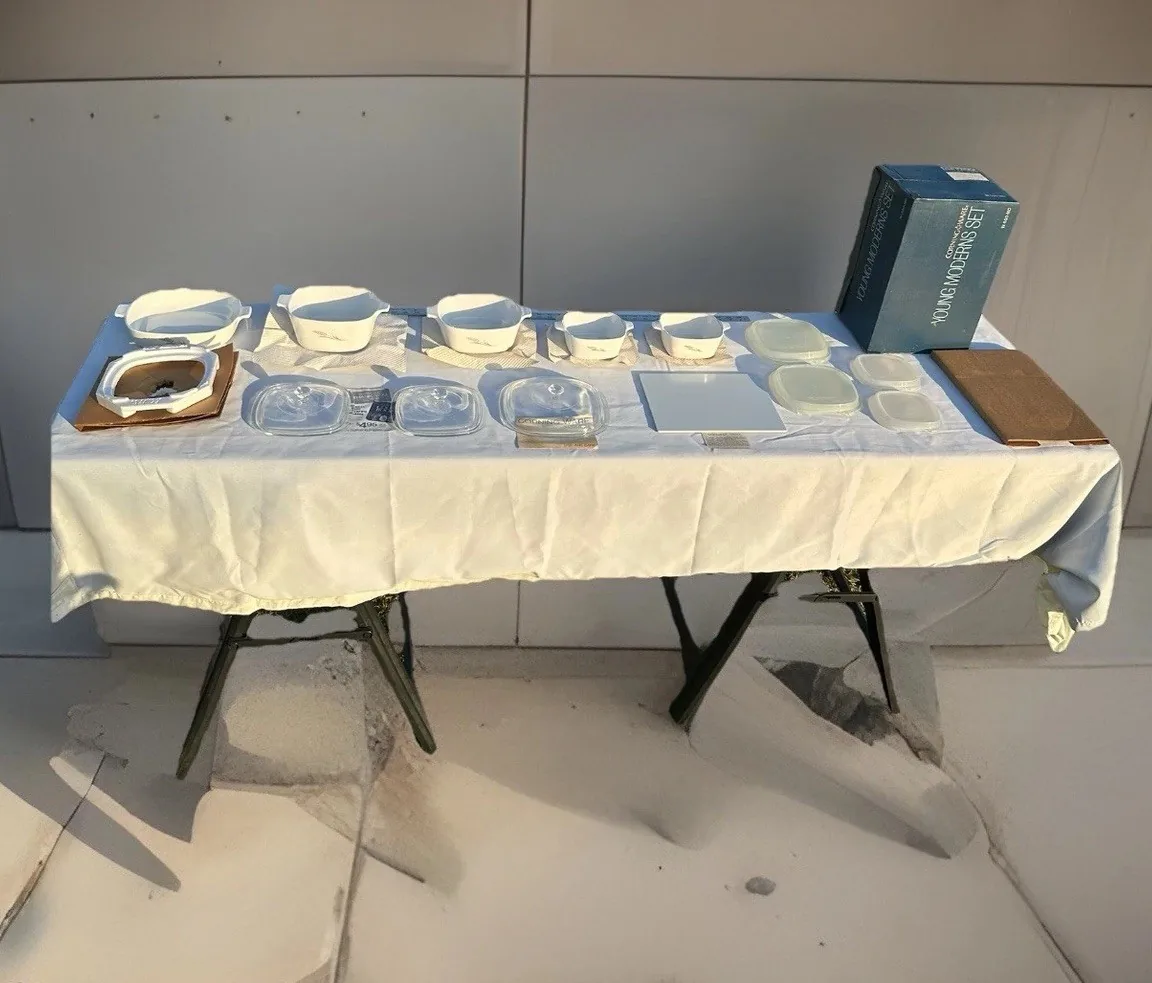
The piece that prompted this post is exactly that: a new-old-stock boxed CorningWare Wheat set — five dishes with lids plus the ceramic trivet, model-marked in the W-series, apparently packed away and simply never used. The gold wheat decoration is crisp, the white Pyroceram bodies are unscorched, and the box itself survived — which almost never happens, since cookware boxes were the first thing thrown away.
We've photographed the set thoroughly, including the model markings and box, so you can verify everything yourself. See the full listing here.
What to look for if you're hunting Wheat
- The pattern: golden-tan wheat stalks, screened as a band on the dish sides — not to be confused with Corning's later harvest-themed patterns.
- W-series model numbers: Wheat pieces carry W-prefix model numbers on the backstamp.
- Condition tells: original lids (the glass lids were shared across patterns, but fit matters), no stovetop scorch rings, sharp unfaded decoration.
- Boxes multiply value: original packaging is dramatically rarer than the dishes themselves.
One honest note, because the Wheat story is often embellished online: production records from Corning's early years are thin, and much of what's known comes from patient collector research rather than official archives. We describe what we can verify — the markings, the contents, the condition — and photograph the rest so you can judge it with your own eyes. That's how every object in the archive is documented.
If Wheat is the grail pattern on your list, the full record is here — and if you're chasing a different pattern, message us. We find things. It's what we do.