How to Tell an Original Oil From a Print — Using a Swamp Painting as the Example
Estate sales are full of paintings, and most of them aren't paintings.
They're prints — sometimes good ones, sometimes textured to imitate brushwork — sitting in frames that cost more than the art. That's not always dishonest. Half the time nobody in the family ever knew the difference, and the label fell off in 1974. But it means the question is this actually painted? is the first one worth answering, and it's answerable in about thirty seconds without any expertise at all.
A signed cypress-swamp oil came through here recently, so we'll use it as the worked example.
1. Look at it sideways
This is the one that settles most cases. Turn the piece until light rakes across the surface at a low angle instead of hitting it straight on.
Oil paint has thickness. Where the painter loaded the brush — a highlight on water, the edge of a cloud, the bright side of a tree — the paint physically stands up off the canvas and casts a tiny shadow. Where they scrubbed it thin, the weave of the canvas shows straight through the color.
A print is flat. Textured prints exist and they're built to fool exactly this test, but the texture on a print is a repeating mechanical pattern that ignores the image — it runs the same across a bright highlight and a dark shadow. Real brushwork follows what's being painted, because it is what's being painted.
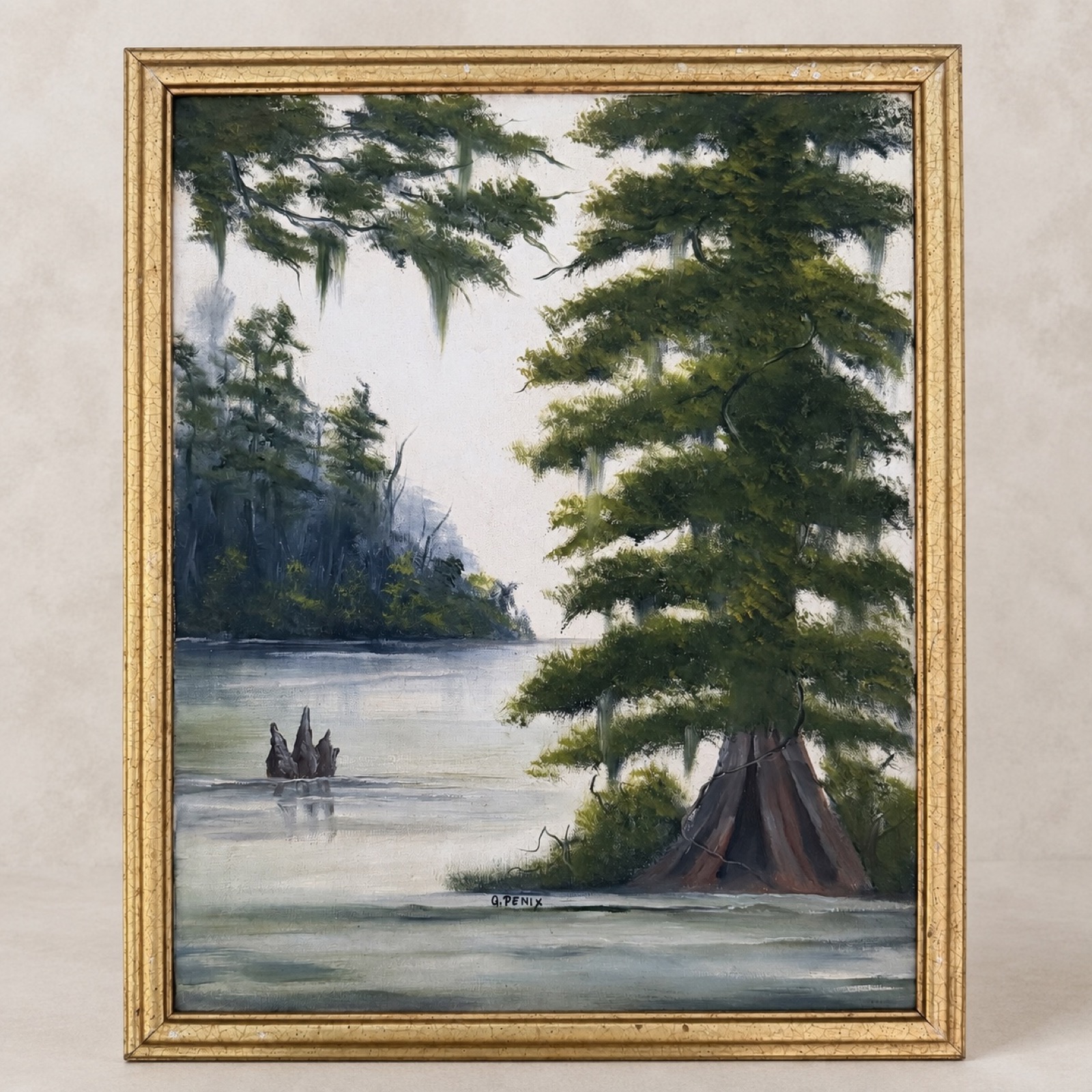
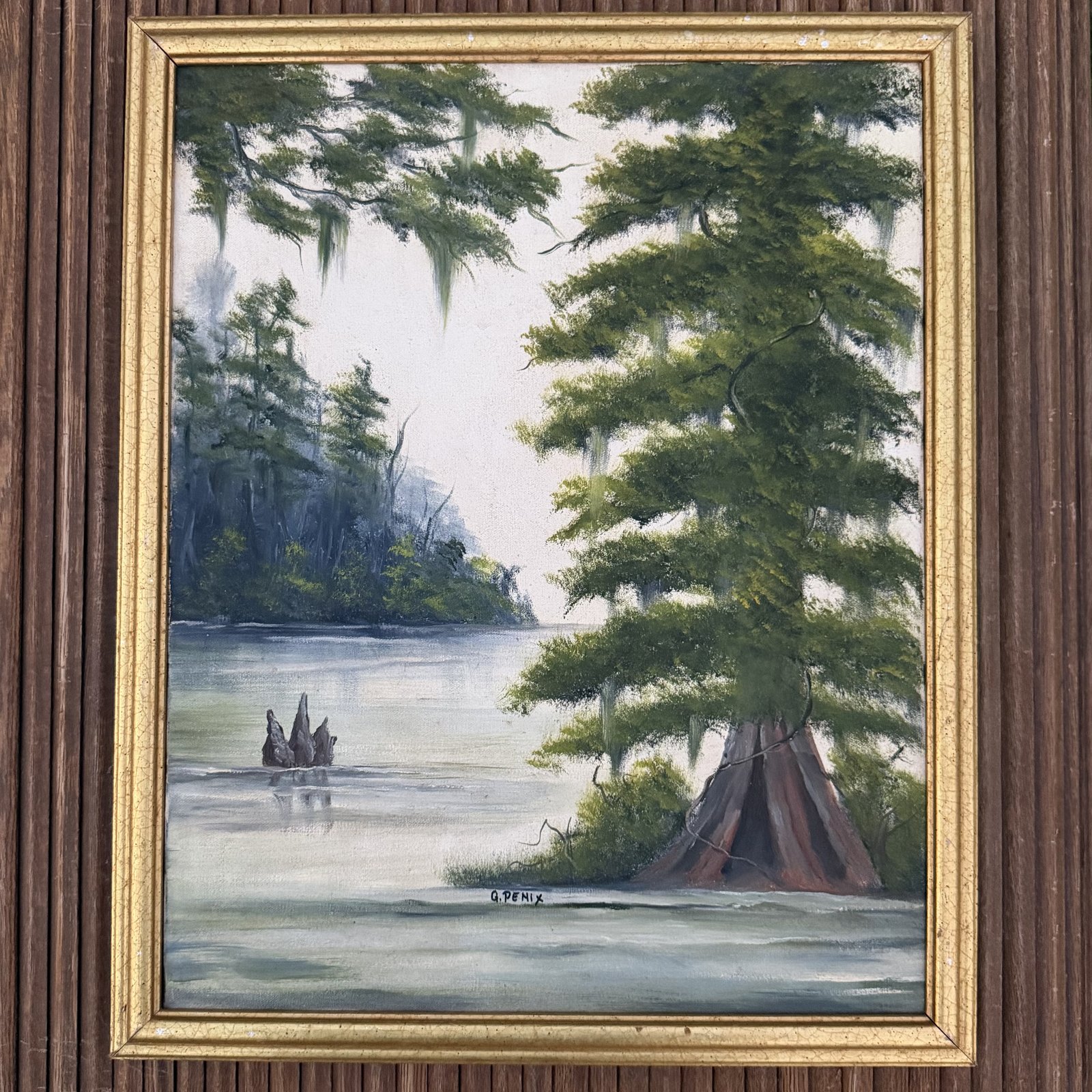
On the swamp painting, the thick passages are in the cypress foliage and along the water's edge, and the canvas weave reads through the pale sky where the paint was laid thin. The texture tracks the picture. That's a painting.
2. Get close enough to see dots — or not
Put your eye a few inches from the surface, or use your phone's camera zoomed in.
Most printing lays the image down as a grid of dots or a fine regular pattern. Paint doesn't do that. Under magnification, paint is continuous — pigment blending into pigment, with the odd brush hair or dust speck caught in it. If you see a repeating dot grid, you have a print, and no amount of frame changes that.
3. Check the edges of the canvas
Look at where the canvas wraps the stretcher, or lift the piece and look at the sides.
A stretched painting usually has paint slopping over the edge — a painter working the front doesn't stop neatly at the corner. A print mounted on board typically ends in a clean, machine-straight line, or the image simply stops at the edge of a sheet of paper.
4. Look for the artist actually being a person
Prints are perfect. Paintings aren't, and that's the tell.
A hand-painted piece has small asymmetries — a branch that changes its mind, a slightly heavier hand on one side, a place where the paint got worked and reworked. On this swamp scene, the vine that climbs the cypress trunk wanders in a way no repeating process produces, and the cypress knees standing in the water are each shaped a little differently.
The signature counts too. This one reads G. Penix, low and to the center, painted with a fine brush directly onto the surface — the stroke sits on the paint, not printed underneath it. On a print, the signature is part of the image and lies in the same flat plane as everything else.
5. Judge the frame separately from the art
Frames and paintings get separated and remarried constantly over eighty years. A great frame does not make the art good, and a beat-up frame does not make it bad. Price them in your head as two different objects.
The frame on this one is gold-finished wood with fine craquelure all through the finish and a few small paint losses along the top and lower rails. That's honest age on the frame — and it says nothing at all about the canvas inside it, which is clean and sound.
What this one actually is
An original oil on canvas of a Louisiana cypress swamp: a big buttressed cypress on the right with a vine running up the trunk, Spanish moss hanging off the overhanging branches, cypress knees breaking still water, and a blue-grey treeline dissolving into a pale sky across the far bank. The canvas is 16 by 20 inches; framed it's about 18 by 22. Signed G. Penix.
We don't know who G. Penix was, and we're not going to invent a biography to make the piece sound better than it is. What we can tell you is what's in front of us: it's hand-painted, it's signed, it's in sound condition, and somebody in this part of Louisiana painted a swamp the way it actually looks from a boat.
Run these five checks the next time you're standing in somebody's carport at 7 a.m. with a folding table of framed art in front of you. Most of it will be prints. Every so often it won't be.